Thursday, August 12, 2021

Saying Goodbye - Brought to You By...

This is one of those podcasts I was truly sad see come to an end. It's started out called Household Name with a tagline of "Brands you know, stories you don't". The entire idea was a deep look into one aspect of a brand that was a household name - Pizza Hut, Coca-Cola, Jack Daniels, Whoopie Cushion, etc. The show was produced by Business Insider and the original host was Dan Bobkoff. When Dan left Business Insider in 2019, Charlie Herman became the new host and the show got a new name, though you can see the branding didn't change.

Brought to your by... Logo

Household Name Logo


The content didn't seem to change much either, for which I was grateful, and episodes continued to be produced throughout 2020, for a total of 62 in the show's run. This means if you haven't listened to it yet, you've got plenty of listening to enjoy.

Brought to you by... (aka BTYB) was a business show at the core, something that isn't always a win for me. Some business podcasts are really boring if you aren't actually into finance or a specific industry. But the cool thing about this was that the vast majority of these brands were either ones you actively used, had used, or were familiar with. I've never used an electric scooter, but the episode about the Scooter Wars was relevant because they are everywhere. Pan Am was before my time but learning about their involvement in the Vietnam War was eye opening. 

They also did listener stories about their interactions with various brands. Listener stories have a way of irking me (mostly because I'm somewhat sensitive to certain tones and that seems to resonate more over headphones of any kind) but I found they kept them short, relevant, and generally funny. They also had people who would call in and ask product questions, then a producer or researcher would come on to answer those questions after they found answers. You get the sense that they all enjoyed learning these new aspects about brands and we all know authenticity is a key component to podcasts.

I highly recommend this in both forms. Episode 1 posted on July 25, 2018 with an episode about TGIF being the Tindr of the 60s. The podcast can be found here or wherever you get podcasts. Farewell, BTYB, you're missed.

Current State of (my) Podcast World


For reasons I won't expound on, I temporarily lost access to my phone and had to use a substitute until the global chip shortage allowed me a new one (new phone acquired, order is restored). However, in doing so, I spent a month with little storage or processing space and a phone that could not run some apps, including my Google Podcast app. I love the Podcast app, I like the layout and interface, but for a month, I had to access podcasts on my phone via the web. This showed me exactly how many podcasts I am subscribed to and it's...a lot. 

Most of them are single season investigative reporting or limited series sort of things, which are nearly always my favorite. But they're cluttering my space and trimming dead wood is my current focus, so I want to unsubscribe from them if they are no longer publishing to that feed. As long as I stay on one podcast from each studio, I'll still get the new show updates that I currently get a dozen times over from podcasts that have been done for a few years. 

Before I remove them, though, my sense of completion and desire to get things I loved more visible means I need to review them here. So I'll be doing that and adding the label "complete" to indicate the run is done and unlikely to update (i.e. some of the investigations are ongoing or in courts so those I will keep while they keep updating as developments unfold). 

Also, a note on this - Parcast has decided to move all their shows exclusively to Spotify. As I don't use Spotify, I am no longer listening to anything they put out except International Infamy by Ashley Flowers (of audiochuck) because it's still updating. It's a limited series as well, so hopefully it finishes out on Google. Parcast was always hit or miss since they get very sensational about true crime in a way that can be uncomfortable, but a few of their shows were enjoyable (Cults and Medical Murders were my favorites). I really hope this does not start a trend of moving to exclusive platforms but given Spotify has decided to get aggressive about beating Apple Podcasts, I have to assume this is something we're going to see. 

The other side of this is that Crime Junkie has decided to make an app for their show. It's incredibly well done and I unsubscribed from them on Google Podcasts after confirming it won't hurt any of their metrics. I'd love to see an audiochuck app since I follow all of their shows, but the CJP app is really good if you listen.

Thursday, December 31, 2020

2020 Retrospective

It would be easy to focus on the things that didn't go as planned this year (i.e. most of it). We've all had our lives turned over. But I'm going to try to focus on the positive for my retrospective. Start as you mean to go on and my focus this entire year and into the next has been a focus on the positive.

Lady Vivienne
Indy doing yoga
My family grew this year. My 3rd nephew, Dawson, was born in August, healthy and strong. My sister continues to do well despite the disruption of COVID as a teacher and her husband being an essential worker (if your power is on, thank a lineman). I have a new kitten and she has brought us much joy. Indy continues to truck along, an old boy now. at 13 He's as healthy as a geriatric dog can be and still has the energy to get his nightly walk. My girlfriend and I have grown closer during quaruntine and gotten through it together. 

I hit my 2 years at Humana this month. Since January, I've been in a great role as a process consultant. My team is fantastic, people I really enjoy working with. The role was designed as work from home, so I didn't have to change modes when the Humana workforce was moved home. It's been an honor to work for a company that has taken the health of both their employees and the members so seriously. Watching their efforts to offset secondary effects of the pandemic - food insecurity, isolation, extra costs - has been incredible. And the fact that Humana is doing well means I can afford to support others is less stable situations, which has been a habit I hope to maintain going forward.

After 19 years and countless hours worked, I left the org after the behavior of their Board showed that they were taking actions to avoid being held accountable. I am always willing to help a group grow and do better, but when the leadership shows itself to be unwilling to change and to be taking active efforts to punish those pushing for change, I will not give them my time and energy. It was an easy choice, in the end, and I haven't regretted a day of it. Along with this came several people showing their true colors. Removing their toxicity from my life has been a joy and I am grateful to them for making it so easy.

This has freed up my energies for other, purposeful hobbies and we've been choosing carefully. It's been toes in thus far, given the pandemic means most groups are limited in their ability, but I'm happy with the choices we've been making. I expect to see this grow as gatherings resume in 2021.

At the very beginning of the year, I found a yoga studio I love. While my ability to practice in studio has been limited by the pandemic, I've been able to support them as they develop an online presence. Even better, I've made a close friendship with the owner, who happens to also be a fantastic person. A very unexpected but very welcome surprise for the year.

Jennifer's brother moving to Phoenix has brought family and the prsence of a toddler, which has been a wonderful experience for us. Having her around and getting to be aunts is so much fun. One of the most important relationships in my life is with my aunt and I'm glad we're getting to develop something similar with her. Her parents are lovely people and having this family unit locally has been a true joy.

Also, the Dodgers won the World Series. Just needed to make sure that was recorded.

We have been exceedingly lucky this year and I am grateful for it. 

Saturday, November 7, 2020

Why I Support...Swindled


There is very little that makes me as angry at white collar crime. Partly because it so often takes advantage of people in precarious situations and partly because it's so rarely prosecuted. But hearing about it is key, especially since the lack of prosecution often allows this brand of criminal to return to public life without any consequences. Enter Swindled.


Swindled in an independent podcast produced by an anonymous host called A Concerned Citizen (ACC). He speaks in an even and almost monotonous voice, which took me a little time to adjust to. I've grown to truly appreciate it because it lands some of his sarcasm incredibly well and because the topics are so infuriating that outrage on his part would be overdone. Each episode covers 2 swines - an intro and then a connected main story. ACC is unafraid of backlash and, in true Millineal fashion, posts the complaint emails and DMs he gets to his IG feed (which I also follow). This is also seen in his choice of targets - he's gone after Dole and the banana republics, Mother Theresa, the Space Program, con artists, politicans, and public servants. The first episode I listened to was about the Dalkon Shield, which Crime Junkies also did as a crossover. I have never been so enraged by a podcast and I was hooked.

From a design perspective, the music is excellent (music is produced by Deformr (aka Trever Howard) and each episode gets some killer artwork, much of which becomes available as various types of merch. ACC clearly cares a lot about his work and I appreciate how much research and sheer time is involved since he's a mostly single-man enterprise.

I am a Patron on Patreon for Swindled and I've been eyeballing merch though I haven't gotten any yet. Mostly, I needed access to extra episodes (I have a problem). As large podcast networks start popping up and consume independent entities, supporting independent or small podcast entities it critical in determining what kind of programming will be available in this media as it continues to grow. As ACC likes to say, it sucks to live in late stage capitalism and try to create something, but rent must be paid.

Money truly is the root of all evil.

Sunday, July 26, 2020

Why I Support...NPR's Up First


We all know the world is on fire and there are very few outlets any of us have right now where that isn't on display. That's not necessarily a bad thing - we should be aware of and invested in the lives and experiences of others, especially when it's outside our usual functioning. Empathy for the struggles that others face should be our goal. But the overwhelming nature of how many things are currently awful does not make it easy to digest what else is happening in the world or actual newsworthy items among the chaos.

Up First
Up First is an NPR podcast, so my support for it is part of my donations to the local NPR station (mine is KJZZ in Arizona). I've always supported NPR, wherever I lived, starting with WAMU in DC. It both acclimates me to the local culture, which is crucial when you move often, and keeps me nationally and internationally informed and aware. I listen to a lot of NPR podcasts I'll eventually go through, but this one is first.

Up First is a brief morning podcast Monday - Saturday. The hosts are familiar to anyone who listens to NPR -  Rachel Martin, Noel King, David Greene and Steve Inskeep during the weekLulu Garcia-Navarro and Scott Simon on the weekend. It's short - about 15 minutes - and covers 3 major stories. It's not the full Morning Edition but it is a really brief overview of major stories of the day.

The true value I have found in this is that getting this brief update on news that is valuable helps innoculate my mind from doom scrolling through various feeds, numbingly seeing but not really absorbing anything. It has done wonders for my mental health. I enjoyed it before all of this started as a quick update, but now it is a tool against the mental stress of the current world. 

Tuesday, March 3, 2020

Why I Support...Crime Junkies


True crime is a genre that is everywhere. Between Netflix, podcasts, and miniseries, it's having a moment. The problem I run into is that I get pretty gross feelings about true crime as entertainment. It's someone's life you're gawking at and, by the nature of the genre, not one they usually have any say in how it's portrayed. So I have some benchmarks for consumption of true crime that basically come down to if it feels like advocacy vs shock factor or pure entertainmnet.

Crime Junkie is a podcast produced by friends Ashley and Brit. They talk through one case every Monday. The cases are often designed around advocacy - they have contributed money to the DNA Doe project as well as family member's advocacting for changes in laws or attention being paid to their case. They try to focus on underreported demographics, such as people of color, whose disappearances don't get as much attention as white victims. And this is why I support them - I am a Patron on Patreon, as well as a purchaser of their merch (the Season of Justice muscle shirt is my favorite yoga shirt). They are self-produced and if you listen through their backlog, you can hear the way they've grown. 

Ashley and Brit are a super relatable friendship that has spanned most of their lives. They are also big supporters of dogs (Ashley's dog, Charlie, signs off every episode and their company, audiochuck, is named for him). Once a month they do a Pruppet of the Month to showcase a listener's dog and use it to raise awareness for dogs available for adoption in various areas. The pictures on their website of the Pruppets are too cute. Also, go back in the history and listen to Brit force Ashley to give up doing Pruppet of the Month because she couldn't get through them without crying. Brit runs them and now Ashley's sniffles are just in the background. 

Their friendship is what makes it an enjoyable listen to me, their heart for victims and advocacy work does good for my soul. I've donated to their causes, signed petitions, and supported the podcast and merch store. 

Take a listen. Check out the information on their website. Maybe make a If I Go Missing file. If you like true crime, this one might be for you - especially if you get the icky feeling using someone's worst day as entertainment.

Be weird. Be Rude. Stay Alive.

Friday, February 21, 2020

A Little Realignment

It's been not quite a year since my last post. Things have been busy and I have had little bandwidth for unnecessary and added stress. But I like blogging about the podcasts I'm listening to, so I decided to reformat.

I will be going over individual podcasts, which will be categorized as:

Why I Support... for podcasts I financially support on Patreon or through merchandise purchases

Why I Listen... for podcasts I listen to but do not support

I will tag them with various categories, including by podcast studio if they have one, and keep a running list in the sidebar of the blog.

So that's the plan. Hopefully I can update regularly until they are all up and then it's just a matter of keeping current. The goal, to provide information on podcasts for those seeking something to listen, remains the same. Let's see how this works.

Sunday, March 3, 2019

Rosenstrasse

Back in 2010 I planned my first Jewish wedding. It was an awesome experience, in part because I got a learn the beautiful marriage and community traditions of Judaism and in part because the couple were just incredible people who needed help getting married. It was my honor to provide that help and then to remain in their lives since.

Particularly, Jess has been a wonderful person. She has shared her culture and been kind enough to answer many questions, to patiently point out when I'm wrong, and graciously accept apologies. Basically, she's what we all hope to be.

And now she's created a game, along with her creative partner Moyra. The game is best described by their own words, which you can read in the Campaign section of their Kickstarter.

Whether you like supporting women, independent games, historical and cultural education, or just an awesome person, you should support this game. I did.

Rosenstrasse Kickstarter

Friday, March 1, 2019

Februrary Podcast Review

This month I added to my ongoing, cleared 3 more terms ones (OMG Slow Burn is so good), and added to my On Deck circle. Oh, and the biggest news...I have a pretty logo, courtesy of my friend GG. It allows me to post on Instagram!


See, I can social media...

Ongoing

10 Things That Scare Me - This one calls itself a tiny podcast, which is accurate given the episodes are about 6 minutes. They are just people running through a list of what scares them, with some elaboration. There are a lot of people that are familiar and it's a nice background noise kind of podcast.

After the Fact - biweekly - Every episode is centered around a statistic and digs deeper into the background of that statistic. The episodes are around 20 minutes.

Anthropocene Reviewed - John Green - monthly - John Green reviews 2 unrelated topics on a 5 star scale. This month it was Velociraptors and the film Harvey. The latter was particularly touching. The former was recommended by his son.

Awesome Etiquette - Lizzie Post and Daniel Post Senning - weekly - This is presented by two of the Post kids on behalf of the Emily Post Institute. An ongoing foray into modern and historical etiquette.

Battle Tactics for your Sexist Workplace - Jeannie Yandel and Eula Scott Bynoe - biweekly - I heard these hosts on Unladylike and I love them. They tackle different aspects of work life, how it's sexist, and how to address it. I'm excited for the second season to get under way.

Cults - Greg and Vanessa - weekly on Tuesdays - This covers a cult, usually in two episodes. I find cults and the psychology of the people who lead and join them really fascinating. My only quibble is this group puts everything older than 6 months behind a paywall at Stitcher. These hosts also host one on Serial Killers, which might end up on my list at some point.

Getting Curious with Jonathan Van Ness - Jonathan Van Ness - weeklyish - JVN, of Queer Eye fame, goes into a different topic each week with an expert. I've gotten a lot of other podcasts from him and he's the reason I joined Instagram. Mostly, he's pure joy, though some people might find his boundless enthusiasm, quick delivery, and vernacular somewhat grating. He's definitely a post-tea listen for me, but then I can listen for hours. I've been slowly listening through his back catalogue.

Lifemancy - Rachel Wilkinson - 2x a month (new moon and full moon) - The newest podcast on my ongoing list, this one is presented by my friend Rachel and explores various aspects of magic and the occult, where it overlaps with science and culture, and how you can take aspects away from it even if you don't buy into it all. If nothing else, listening to Rachel will make you laugh and leave you happier.

Make Me Smart - Kai Ryssdal and Molly Wood - weekly - Kai and Molly deep dive into various economic, technologic, and cultural topics, some of which connects back to things touched on in Marketplace.

Marketplace - Kai Ryssdal - daily Monday-Friday - I loved Marketplace on NPR, but I'm never in my car anymore since I bike to work. I listen to the previous evening every morning. My understanding of world and national economics is due to this program and Kai's voice doesn't grate me early, so this is the first one I listen to at work.

Marketplace Morning Report - various - 3x daily Monday-Friday - To add onto the Marketplace knowledge, these are short (around 7 minutes) updates in the morning that give a brief view of financial and economic news. They're done via the BBC.

The Moth - 2x a weekish - The Moth hosts live storytelling and the podcasts are collections around a topic. The individual stories are around 10 minutes each and the episodes are generally about an hour.

The New Yorker Radio Hour - weekly - This podcast pulls on writers and contributers to the New Yorker, highlighting books reviewed or stories published.

NPR Politics - I love this podcast! A few reporters on differet topics (Congress, The White House, voting, etc) get together when there is political news to report, including an end-of-week roundup. Generally pretty short and covering a variety of topics, but awesome. A good nonpartisan overview.

On the Media - Brooke Gladstone and Bob Garfield - 2x a week- Another NPR segment I like that looks into various issues related to the media, usually around a central topic. They are often very critical of their own industry, which I like hearing.

This Movie Changed Me - Lily Percy - biweekly - I caught an episode of this on a long car ride on NPR and started listening to it when it released. Every episode is a conversation with someone about a movie that changed their life. It's amazing. Hasn't updated since October 2018, so I'm itchy for a new episode.

Unladylike Cristen Conger and Caroline Ervin  - weekly - All caught up! These girls are great in their continued exploration of the patriarchy and its effects. A personal favorite - they are the first to say that, as white women, they don't have a full view of the damage patriarchy does since they're protected by whiteness, so they have taken a lot of efforts to showcase women of color, as well as queer women.

Term

Broken Harts - Remember the story about the two white women who adopted 6 black kids and then drove off a cliff, killing everyone? I'm a sucker for true crime and this one was intriguing. Also, it's presented by Glamour, which is a magazine I've been subscribed to for 14 years. Very interesting, very detailed.

Slow Burn - I got this one from the NPR Politics podcast. Season 1 covers Watergate in incredible detail. Season 2 is the Clinton Impeachment. The focus of both is what it was like then, in the moment of it happening, and the results are incredible. I've thought a lot about the similarities between them since listening and there's probably a future blog post about it. They haven't said anything about a season 3 so I'm calling it term.

Standoff: What Happened at Ruby Ridge? - This one came from Slow Burn, as both are productions of Slate. It's a 5 episode dig into what happened during the standoff at Ruby Ridge and the results of the investigations and cultural impact. I have never really understood it so it was a really great listen.

On Deck

Boom! Lawyered - I heard about this one from Unladylike when one of the hosts was on the show. Looking forward to getting a better view of the legal system.

BackStory - I heard one of the hosts (Nathan Connolly) on one of the Slow Burn live episodes and it made me want to listen to him more, so I found his podcast. There are others on here as well but he's why it's on my list.

Katie Couric - I listened to Katie on JVN's podcast and adored her, so I want to give her show a listen.

Rachel Maddow presents The Bag Man - I love Rachel Maddow. I want to see if I love her podcast. It's about corruption in politics so...probably.

Small Doses with Amanda Seales - I heard Amanda Seales on Unladylike (so many good guests!) and I liked her, so I want to see if I like her for a number of episodes.

Still Processing - Wesley Morris was on Slow Burn. I loved his commentary so I'm following his podcast.

Tilted: A Lean In Podcast - So I have some serious issues with the whole Lean In thing, mostly because it was aimed a very specific segment of the population but presents itself as doable for anyone. That said, the podcast is supposed to be about the challenges and ingrained misogyny in the workplace. I'm withholding judgment.

Sunday, February 24, 2019

How do you define....?

The first time I used to word "troll" to describe my mother (she is, it's cute) I got an odd look from her and my father both. This is not the first time I've used words that have not entered their lexicon, so I explained, because a common vocabulary is the baseline to good communication. My parents laughed.

Apparently, when they were young (60's and 70's) "trolling" was cruising for a date. In my hometown in Shawnee, you'd "cruise the 'Poo" (Kickapoo is the main street). For them, it would have been "trolling the Poo", which doesn't have the same ring.

It was the result of a generational difference in language. I love how language evolves and changes over time, the way words take on new meaning or context. I find that people who seek, as my parents do, to understand the way the generations after them use language rather than dismissing it as irrelevant have an easier time adjusting to the changes in the world...and the world changes quickly with technology connecting us in a way that would have been unheardof to my grandparents. That said, I text with my grandparents often. People can change with the times, if they aren't afraid of the changes or holding too hard onto a past that's gone.

I think another word that has had both a change of meaning but also a generational difference in understanding is socialism. My podcasts have talked a lot about the way many Democrats are embracing the word and how defining it will likely be something we will be seeing a lot over the next couple of years.

The Iron Curtain fell when I was about 9 so most of my life has been spent post-Cold War. I have an aunt who is from Russia and who has talked a lot about the terrible of living in the USSR and it's fascinating. But when my generation and later is talking about socialism, we're not looking at other countries, we're looking at ours.

At how Social Security and Medicare are regularly spoken of as two of the most important programs we have (and which our grandparents fight for zealously) and which are prime examples of socialism.

We look at the failings of rampant capitalism, how a lack of government involvement makes our country the most expensive healthcare in the world but we don't even have paid leave when someone gives birth; how people have a 4-year degree, student debt they can't pay, and are working for minimum wage, which can't even cover their housing costs. Housing costs that continue to rise while wages remain flat.

So we look at this country, which has a few really successful programs that are clearly socialism but a bunch of really failed areas (areas that effect our generations in way they don't effect the ones before us) that have been left to the ravages of unchecked capitalism. We aren't afraid that socialism will lead to communism because...well, it doesn't. We're more interested that democratic socialism would lead to homes, job, wages, healthcare, a chance at a life our parents and grandparents got a chance at...and then voted to dismantle for us.

For us, socialism isn't a scary threat from outsiders. We have time and history to look at and since our history books focus almost solely on European and Western history, we had them fed to us year after year. We can see what has gone well and what has gone terribly. And our thoughts have been formed accordingly.

If the word "socialism" causes you distress coming out of the mouths of your loved ones, I think the first thing to do is to ask them what they mean. Listen to what they're saying. It's possible that you and they are using two very different defintions for the same word. And try to look at the world through their eyes, through the eyes of their contemporaries. Our world is different than the one you were in at our age. We may well need some different definitions to navigate it. The question is, will you hold onto the past that is gone, afraid to change your understanding or adapt your definitions, or will we navigate it alone?

Saturday, February 2, 2019

January Podcast Review

As I mentioned in my last post, I have been listening to a lot of podcasts lately. My job ensures at least a few hours, and sometimes all of them, are spent at a computer and so I can listen. Podcasts are interspersed with music.

To me, podcasts are defined in two categories: Ongoing and Term. The first is as it says - an ongoing podcast that revolves around a topic or a presenter. The latter is one that is a limited number of episodes based on the topic. The last set are the ones on deck for my next listening.

I've linked to the podcasts and I listen on Google Play, to which I have a subscription. These should all be available anywhere you listen.

Let me know if you start listening and what you think. Also, I'm always looking for recommendations!

Ongoing

Anthropocene Reviewed - John Green - monthlyish - This is my first introduction to podcats. John Green (of vlogbrothers and authorial fame) reviews 2 unrelated aspects of the anthropocene (the era of humans) on a 5 star scale.

Awesome Etiquette - Lizzie Post and Daniel Post Senning - weekly - This is presented by two of the Post kids on behalf of the Emily Post Institute. An ongoing foray into modern and historical etiquette.

Cults - Greg and Vanessa - weekly on Tuesdays - This covers a cult, usually in two episodes. I find cults and the psychology of the people who lead and join them really fascinating. My only quibble is this group puts everything older than 6 months behind a paywall at Stitcher. These hosts also host one on Serial Killers, which might end up on my list at some point.

Getting Curious with Jonathan Van Ness - Jonathan Van Ness - weeklyish - JVN, of Queer Eye fame, goes into a different topic each week with an expert. I've gotten a lot of other podcasts from him and he's the reason I joined Instagram. Mostly, he's pure joy, though some people might find his boundless enthusiasm, quick delivery, and vernacular somewhat grating. He's definitely a post-tea listen for me, but then I can listen for hours.

Lifemancy - Rachel Wilkinson - 2x a month (new moon and full moon) - The newest podcast on my ongoing list, this one is presented by my friend Rachel and explores various aspects of magic and the occult, where it overlaps with science and culture, and how you can take aspects away from it even if you don't buy into it all. If nothing else, listening to Rachel will make you laugh and leave you happier.

Marketplace - Kai Ryssdal - daily Monday-Friday - I loved Marketplace on NPR, but I'm never in my car anymore since I bike to work. I listen to the previous evening every morning. My understanding of world and national economics is due to this program and Kai's voice doesn't grate me early, so this is the first one I listen to at work.

On the Media - Brooke Gladstone and Bob Garfield - 2x a week- Another NPR segment I like that looks into various issues related to the media, usually around a central topic. Brooke's issues with Roseanne Cash was incredible and made me very sad that I couldn't get her albums via Google Play.

This Movie Changed Me - Lily Percy - biweekly - I caught an episode of this on a long car ride on NPR and started listening to it when it released. Every episode is a conversation with someone about a movie that changed their life. It's amazing.

Unladylike Cristen Conger and Caroline Ervin  - weekly - I'm almost caught up with this one! These girls are great in their continued exploration of the patriarchy and its effects. A personal favorite - they are the first to say that, as white women, they don't have a full view of the damage patriarchy does since they're protected by whiteness, so they have taken a lot of efforts to showcase women of color, as well as queer women.

Term

Dear Franklin Jones - I like cults (see above) and I found this one via another one (there's a lot of recommendations in podcasts). A man who grew up in a cult unpacks his parents' involvement and his own feelings towards the cult leader. It's really interesting. 7 episodes

Solid in America - I cannot recommend this one enough. Noor Tagouri created a documentary about sex trafficking and the sex trade in America and this podcast was produced in conjunction with it. It's incredible and goes into sex work from a variety of angles, talking to people we don't often hear from in conversations about the sex trade - the people who work in it. It's a challenge to all assumptions and may require quite a bit of introspection. 9 episodes though Noor has commented there might be some ongoing work here which I would love.

Unerased: The History of Conversion Therapy in America - This one was a bit rough to listen to, but it goes trough conversion therapy and it's history. This was released in conjunction with the film Boy Erased and talks to some of the subjects that inspired the film. Everyone should listen to this, especially if this has never been something in your face before (as it hasn't for most straight people and even a large number of queer people who may have come out later or were from accepting communities). If conversion therapy as a topic brings back bad memories, proceed with caution. 4 episodes.

On Deck

Boom! Lawyered - I heard about this one from Unladylike when one of the hosts was on the show. Looking forward to getting a better view of the legal system.

Katie Couric - I listened to Katie on JVN's podcast and adored her, so I want to give her show a listen.

Tilted: A Lean In Podcast - So I have some serious issues with the whole Lean In thing, mostly because it was aimed a very specific segment of the population but presents itself as doable for anyone. That said, the podcast is supposed to be about the challenges and ingrained misogyny in the workplace. I'm withholding judgment.

Friday, January 18, 2019

Ever Heard of SANEs? Me neither.

I have a planned post that will go over my current and recent podcast list, but one episode in particular struck me and I wanted to share.

An episode of Unladylike discusses the role of the SANE - Sexual Assault Nurse Examiner. This wasn't something I knew existed but is such an incredible role. They are RNs who have taken hefty additional coursework and are able to conduct forensic examinations following a sexual assault, trained to collect DNA and other forensic data in a patient and care centered manner, reducing retraumatizing the patient. They are also connected to and aware of the state and federal rights and guidelines, so they can provide next steps for law enforcement, mental and physical health, as well as patient's rights.

This is incredible...but there aren't many. The SANE who spoke to the program in in Georgia and she's one of just 25 in the entire state. I checked their website and there are none in VA emergency rooms that I saw.

I'm not sure how to create more of these other than to raise awareness. I'm going to look into lobbying the VA to require them in their hospitals, maybe via the DAV (what's the point of having a membership if I'm not using it?).

For more information, you can listen to the podcast and go to the International Association of Forensic Nurses to see what the closest hospital in your area with one is.

Sunday, December 30, 2018

Planning for the Future

In preparation for the end of G+, I'm looking at all my options. I imagine the result will be that I post here more and then follow friends on whatever platforms they go to. I won't be using FB more than I use it now.

So, this is mostly a notice so that people can be following this directly if they want to, rather than through G+. More updates as they happen.

Wednesday, September 27, 2017

Just Another Case of Verbal Assault

It was a pretty night last night (despite unseasonably high daytime temperatures in the 90s) and I was craving Oreos so I walked to a few gas stations until I found one that was open. The lovely lady inside searched but they were out of Oreos so I settled for Oreo ice cream.

As I walked out, there were three men hanging out on the corner. A couple of them had spoken to me separately when I walked in but I was wearing headphones and was able to ignore the comments. As I walked out, all three of them began. Still wearing headphones, I ignored them again. A car pulled into the parking lot and the man inside asked me if I wanted a ride. I ignored him too and walked home.

My adrenaline was up and I was looking over my shoulder every block or so. When I got home, I sat on the couch until it came down. These were not passive remarks. They were crude, vile comments followed by threats when I didn't respond.

This is not the first time this sort of thing has happened. Almost every time I leave the house, there is some commentary and I'm accustomed to interacting with it as appropriate for the situation (an 80-year-old man telling me I have nice gams - actual quote - does not get the same response as a 20-year-old making a similar remark). But alone, at night, walking rather than in the protection of a car (though I have been followed from stoplights in a car so I know that's not as safe as I would hope)...increased risk, increased vigilance. If it had been daylight, if I had a car, if it was one person instead of a group, I might have said something to them. But the area was well-lit, so they would have had to follow me to actually lay a hand, and to do that requires motivation. Engaging might have provided them motivation.

Today I called the store and spoke to a manager. I told her what happened. She apologized profusely and explained the store's policy on loiterers. She said the third shift were new and they might not have been as vigilant about loiterers as they should be. She could quote me police response time, since they call the police if people don't vacate when told to do so. She reassured me they would go over the policies with third shift and make sure they were enforced, continuing to apologize the entire time.

For me, that made a huge difference. Knowing that, if I should come across a problem in the future, I could turn back around, walk into the store, and expect the employees to do something. It's interesting to me that knowing that matters so very much and illustrates how little I expect from a business in response to these sort of incidents. How effective the misogyny in our culture is when the expectation is that, should we be harassed, we're on our own, and if we can't deal with it, that's our failing. We were too weak to fight back, to timid to call it out, in the wrong place at the wrong time, dressed wrong, unarmed...the justification changes to fit the narrative.

This business did good. Circle K on Macon Rd, you did good. Everyone else - do better.

Saturday, February 11, 2017

The Value of the 8th Grade Dance

One of the great joys of being married to a teacher is getting to chaperone 8th grade dances. This might sound like chore, but I jump at every opportunity, which usually includes Homecoming (I have no idea why 8th graders have a Homecoming) and a Valentine's Dance. The latter was on Friday.

As I was watching the kids come in, I thought about why I enjoy it so much. This is my third year as a chaperone and I only enjoyit more every time.  Here's what I came up with.

Enthusiasm - These kids are right at the age when they are still excited for things. They aren't too cool yet. They aren't afraid to care...and they care a lot. It's so enjoyable and something that you won't see again until after they pass the hump into secure adulthood, which seems to happen around 30.

Dancing - So unlike when I was in 8th grade, these kids go to a dance to dance. And they are incredible. The DJ knows these kids and he knows what they like. He keeps them excited and engaged. Some of them are really talented and clearly practice and prepare. And some of them are just happy to dance, skills aside. The prevalence of line dancing never fails to amuse me....how many takes on the Electric Slide exist? But it amazing to watch these kids move.

Fashion - One of the great parts of this is watching them arrive. The girls and the guys are decked out. Bow ties have made a huge comeback and the boys rock them and suspenders both, as well as tuxedos of all shades. The girls wear dresses that are flashy, cute, elegant...they run the range. And then there are the kids who show up in jeans and hoodie without any concern for the disparity in fashion. They are there to dance. The biggest double take for me has certainly been the return of 90s fashion, which is a little jarring.

Drama - Hands down the best part of 8th graders is their drama. It's amazing and has nothing to do with me. I watched a girl march her boyfriend all around the room, basically ignoring him as she hung out with her girlfriends. The Proto Plastics group all came with boys but had no time for them as they discusssed Valentine's Court drama. There is always something going on that is hilarious because it matters to them a lot.

Anyway, I love these dances every time and I always look forward to it.

Tuesday, December 6, 2016

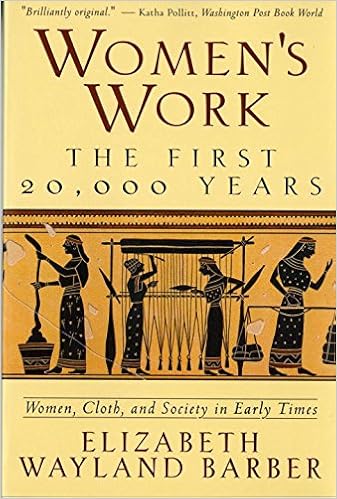
Review: Women's Work: The First 20,000 Years - Women, Cloth, and Society in Early Times by Elizabeth Wayland Barber

I came across this book as part of the reference material in another book, which is often how I develop out my reading list, hopping through topics like stones across a creek. Though I purchased it last December in a post-Christmas book buying, I didn't start it for several months. Even so, this is not what I would call a quick read. It's an academic text written by an archaeologist (and weaver). Thus, it takes a methodical look at the evidence (and lack of evidence) around the work women did in the first 20,000 years of civilization. It requires a level of mental engagement that prevented it from moving quickly.

I didn't realize what I was getting into when I bought the book. I'm not sure I even knew what I was expecting until I got to chapter ten, Behind the Myths, in which she discusses the fascinating correlations between certain items of myth (such as a shirt dipped in dragon's blood will kill the wearer) and textile knowledge of the era (that there was a dye favored by royals which was nicknamed Dragons Blood and, if left in contact with the skin for a duration, would absolutely kill someone). That entire chapter was incredible, but I wouldn't have been able to enjoy it the way I did if she hadn't spent the previous nine chapters laying out the development of weaving, dying, sewing, and other crucial skills of the era. Just as I didn't know what I was expecting from the book, I didn't know how to accomplish it until the author did it for me.

History in this sense is not my forte. I love history for the stories it imparts and the lessons learned, but dates have never stuck well in my head, and so while I can recite entire sagas of the English Monarchy and discuss at length why Queen Victoria conducted her court as she did and how it influenced the courts of her descendants all the way through Elizabeth II, I have a rough time remembering when she ascended the throne. Thus, the first several chapters which are discussing the development and migration of society, and the references to those dates throughout are a bit lost on me. Barber, however, is a professor and has clearly encountered people like me before, so she provides graphs to help me follow along.

Speaking of her provided aids, Barber makes incredible use of her artistic skill to reproduce a number of important visual references. Early in the book, she shows how actually taking the time to try to reproduce historic weaving teaches a great deal about the context is which it is created, and provides the pictures of her own work doing so. When she talks about a Nineteenth Dynasty Egyptian weaving shop painted on a tomb discovered in the thirteenth century, she reproduces it for the reader. When she discusses the trade routes men took to sell wares while their women produced them, she draws simple line maps to give an idea of scale and distance. When she suggests that the Venus de Milo, whose arms would be held in an awkward position were they present, is in fact created in the exact position that Greek women held their spinning, she provides an artistic rendition of how the statue would look had the wood and wool accessories not been lost to time.

This makes a huge difference between an academic text and an engaging collaboration in understanding. I got to discover for myself the artwork that shows a change to the type of loom used in Egyptian weaving because the artwork was provided for me to examine. This elevates the text and provides engagement in a way that can be lost in a somewhat difficult topic to grapple with as history measured over the course of centuries.

The last chapter, technically labeled a postscript, was one that really pleased me to see, which was an examination of her methodology. Early in the book she explained that a lot of what constituted women's work in this part of civilization was made of perishable items - food, fabric, farming - and thus discounted for much of archaeology. That she takes such care to discuss how she went about doing the research that led to this book in the face of those challenges was both interesting and reassuring, as a description of methodology is often lacking in academic text provided for mass consumption. It pleased me greatly. She says, in reference to a gentleman who had influenced her in the field, "He never let his ego get in the way of learning, by hanging on to an idea because it was his." Wise words.

The book can be summed up by her last paragraph, and I hope that if Dr. Barber every stumbles on this she will not mind it reproduced here: "We women do not need to conjure a history for ourselves. Facts about women, their work, and their place in society in early times have survived in considerable quantity, if we know how to  look for them. Far from being dull and in need of fanciful paint to make it more interesting, this truth is sometimes (as far as the saying goes) stranger than fiction, a fascinating tale in itself."

The Three Rules of Fashion

I haven't done a post about fashion in a long time. It's not that I don't think about it still, I do (and in fact, I do more than I used to). It's that most of those thoughts are fleeting, thoughts better pursued directly on G+.

And that is where this post originated, before I decided to  move it to Blogger. The reason is the topic feels more permanent, less about the fleeting aspects of fashion (shoulder cutouts, I don't understand...) and more about the permanence of style. Fashion is what they create, Style is how you present. If you're interested in the chatter of various fashion choices, let me know and I'll add you to the Fashion and Style Circle on G+.

The Rules of Fashion

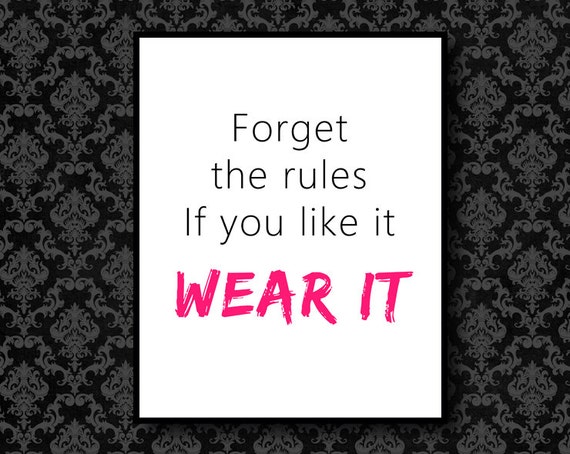
Printable from Modern Mommsie on Etsy.com
Even if you've never followed them, you probably know that the old rules of what one wears are thoroughly smashed. "No white after Labor Day" has been relaxed to clarify that one shouldn't wear summery fabrics (such as white linen) once the temp drops (which might be November), unless you live in tropical areas (such as Florida), in which case the rules don't apply all. Almost every hard and fast fashion rule has undergone a similar obfuscation so that almost anything goes.

This is lovely from the freedom of expression angle and devastating from the "but how do I know if what I'm wearing is appropriate?" angle. Because the truth of the matter is that while the rules have gone, there is still an expectation of  "appropriate dress", which comes will all the cultural baggage of decades past and none of the rules to help one out.

The New York Times published an article back in October called "How to dress like an adult", in which the author addresses this exact issue. How do you mark that you're an adult now when a hoodie and sneakers is entirely appropriate attire for an adult? The old rules about what teenagers wear vs adults is long gone, with girls wearing high heels long before they turn 16 (or 18, depending on the height of the heel) and industry giants not owning a suit because their industry rejects it's formality. Vanessa Friedman, the author of the NYT piece, has distilled it down to three rules (you can call it guidance is rules makes you twitch):

1. Do not distract.
2. Think of your clothes as costume.
3. Learn to iron (and sew, and fold and invest in some good hangers).

She explains how these three rules cover a multitude of areas. She believes the first to be the most important, and it is invaluable, but the third is my personal favorite. The clothes you wear are far less of a concern than how you wear them. I have a pair of brown heels from Payless that I've owned for probably 10 years. I've replaced the heel tap and the insoles and they are my favorite pair of shoes. My personal philosophy of buy the best you can afford and that you really love, then use it until it falls apart, applies to clothing more than anything (it's where I developed the policy). So even though I now buy shoes that have a higher price tag out the gate, I still treat them the same - replace the parts you can replace until the shoes cannot be fixed, then mourn their death and find new ones.

A crumpled Chanel (which is a sin...) looks messy, where as a jacket from Target that is in good condition, ironed, and tailored will take you far.

Thoughts on these three rules?

Wednesday, November 2, 2016

The Stick and I

As I've mentioned before, I sometimes use a cane. I have two of them, actually - the one the VA issued me, which is set to my flat-footed height, and a lovely wood one that is cut to heel-height and the one that is most commonly seen out of the house. Eventually, I intend to have a wood one cut for flat feet so I am more comfortable going out of the house in flat shoes with a cane (I hate wearing flats and pre-disability me rarely did out of the house unless partaking in an activity that required it, like exercise).

My relationship with the cane is complicated. One of the "benefits" of an invisible illness is that we pass as healthy, in my case for over a decade. Family, friends, the world in general all assumed I was healthy or, if they knew I was sick, never really understood the extent. This isn't their fault, I never let them see me as sick. Despite being more visible about it now, there is still a great deal of surprise (and disbelief) associated with my illness.

But you can see the cane. You can't miss it, actually. It draws attention, especially combined with my usual style of dress and appearance. I don't look sick, I'm wearing makeup, I have two legs that usually can be seen because I tend to wear dresses...what is wrong with me? People are curious and I am the curiosity. For those that also see me when I don't need it, the concept that mobility aids are not an all or nothing game can be a struggle. People think of walkers, canes, crutches, as permanent fixtures that are needed 100% of the time. A friend of mine used a wheelchair, but she could stand or walk short distances, which turned expressions of pity and curiosity into disbelief and outrage.

When I read articles about others who adapt to the use of mobility devices, I am reading not only to understand and develop empathy, but also reading my potential future. We have no idea what course my health will take. I may need a cane full-time. I may need to graduate to a walker or the dreaded chair. I look for coping mechanisms, suggestions, ideas, strategies. I struggled for months before I asked the VA for the cane (which they were quick to provide) and even longer before I allowed myself to be seen using it. I put myself through a lot of physical and psychological pain in the process, stressed about what the cane meant to others, what it meant to me, about me. We're approaching a place of peace, the stick and I, and it's a hard won peace. It helps to read that others struggle too and that they overcome the struggle. That does not make me eager to engage in it again, but I'm trying to avoid the sense of dread through education.

I'm told the tendency to respond to every problem with "Education!" is the tendency of a Democrat...

Friday, October 7, 2016

Peace vs Victory

I was listening to Morning Edition on NPR and there is a story about the President of Columbia, President Santos, winning the Nobel Prize for Peace, even after the voters rejected the peace plan he brokered to stop 50 years of war (http://n.pr/2dxcFcm). As they were discussing how Santos became president, with his history of fighting the insurgents, and then his transition once he became president to peace talks, it struck me that, suddenly, he is incredibly unpopular. He brokered a treaty to end a 50 year war...what else do people want?

The answer, I realized, is that the people don't want peace. They want victory. They don't want the fighting to end, they want their enemy destroyed.

Victory is a win-condition. It decimates the enemy, creates a clear victor, deliniates right and wrong. The Civil War, WWI and WWII - these all had victories, where the winners could proclaim themselves to be advocates of peace while the losers were trampled under heel, buried in reparations and debts, stripped of economic strength and, most importantly, their dignity.

Peace is a process. It takes time, it requires that both sides give a little, it takes negotiations. It's hard. No one may come out a clear victor, but the goal is a standing, lasting peace, one that, over time, heals, which means that both sides must retain their dignity, must be able to live and grow under the terms. For true peace, the conflicts will fade away over time. New ones may arise, but they will not be a rehashing of the past, because peace allows wounds to heal.

If we had focused on peace after the Civil War, would we still be fighting the culture wars that arose from making our own citizens feel as their own was endangered, disregarded, wiped out?

Would WWII have happened if Germany hadn't been stripped of their dignity in the Versaille Treaty after WWI?

Would we be fighting ISIS if we had found a better way in the Middle East over the decades of European and American involvement in the region, rather than cutting up their borders and gutting their culture?

Peace is not popular. It does not generate parades. It costs both sides. When you call for peace, ask yourself: Do you want peace or victory? Be honest with yourself. Do you want to be able to sit down at a table with the people you were formerly in conflict with, with dignity preserved on all sides, prepared to give some up yourself for a lasting, true peace? Or do you want to bring them to heel, to show them who is boss, to ensure they don't dare mess with America again?

These are different. They require different tools to achieve. You cannot call for peace and then support actions aimed towards victory, thinking they will achieve the same result.

So be honest with yourself. What do you want? What are you willing to support?

Tuesday, September 13, 2016

Reivew: Red: A History of the Redhead by Jacky Colliss Harvey


As you can see from my profile picture, I am a redhead. Like most of my kind, my relationship with my hair color has been contentious, but I have settled into a happy place of acceptance. My mother has red hair, a brick red shade I have often envied, and I am told a great-great aunt did.

Like me, Harvey is a redhead. Her book covers a large array of topics - the genes behind red hair, red hair in society, mythology, art, literature, television, film, and history. Beginning with the science of it all, the book starts a little dry, but the work is fascinating as she explores what we know about the spread of the gene that creates red hair, as well as what is being theorized in cases where the science gets fuzzy (for example, mummies with red hair don't always mean a redhead, as henna was used as a burial aid and could change appearance of hair following centuries of mummification).

Supporting her discussion of red as the color used to mark extraordinary qualities in art are beautiful photos of paintings and pottery. She specifically talks about the use of the color red to draw attention, making it a natural choice for artists when they want to highlight a subject in their work. The visual aided in the development of some of the stereotypes of redheads as they became associated with popular figures in art, especially Judas, angels, Mary the Mother of God and, most commonly, Mary Magdalene.

Clues of redheads of history are carefully examined. She mentions several qualities that might suggest redheadedness, or have been taken as an indication of such, without actually knowing of the individual had red hair. Because of the way that history works, it is assumed many firey figures of history were redheaded, even if the only words use to describe them were "ruddy", which is more descriptive of skin tone that often accompanies red hair, but doesn't necessarily require it. Personally, I loved her critical eye. I thought it was well applied throughout the book, looking for where supposition departs from fact.

The part of the book that really struck me was when she began discussing modern societal assumptions of redheads, the vast difference between the view of redheaded men and women, and the oft-common shared experience of redheaded children as easy targets for insults and mockery. She lays out comments and responses that I didn't even realize where commonly shared until I read them in the book. It unsettled me that such behavior was widely accepted, but at least I know it's not only me. I am much more critical when I see a redhead on a screen - is she the temptress, the rebel, the troublemaker? The number of times the answer is yes is a little disturbing.

She ends the book sharing her experience visiting Redhead Days in Breda, of which she also included a really beautiful picture, and brings it back to the sense that there is an understanding and shared experience of being a redhead, even if we have different eye color, skin tones (she does a lovely exploration of cultures that boast a regular percentage of redheads who also depart from the stereotypical fair skin and light eyes), and languages. Most of the people she talked to had this in common - that they had struggled with their hair and the undesired attention it brought them, but that they would trade it for nothing.

I think the book would be interesting for anyone who is interested in cultural shifts and trends, the development of stereotypes in Western culture, tropes in television and cinema, art history, or who happen to be a redhead themselves. I expect to reference the book in the future and several items from her "Reading for Redheads" appendix are on my list for future reads.