Showing posts with label books. Show all posts

Tuesday, December 6, 2016

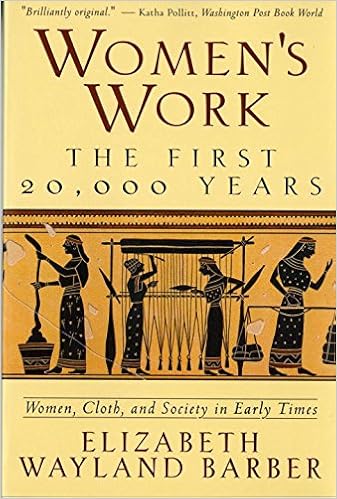
Review: Women's Work: The First 20,000 Years - Women, Cloth, and Society in Early Times by Elizabeth Wayland Barber

I came across this book as part of the reference material in another book, which is often how I develop out my reading list, hopping through topics like stones across a creek. Though I purchased it last December in a post-Christmas book buying, I didn't start it for several months. Even so, this is not what I would call a quick read. It's an academic text written by an archaeologist (and weaver). Thus, it takes a methodical look at the evidence (and lack of evidence) around the work women did in the first 20,000 years of civilization. It requires a level of mental engagement that prevented it from moving quickly.

I didn't realize what I was getting into when I bought the book. I'm not sure I even knew what I was expecting until I got to chapter ten, Behind the Myths, in which she discusses the fascinating correlations between certain items of myth (such as a shirt dipped in dragon's blood will kill the wearer) and textile knowledge of the era (that there was a dye favored by royals which was nicknamed Dragons Blood and, if left in contact with the skin for a duration, would absolutely kill someone). That entire chapter was incredible, but I wouldn't have been able to enjoy it the way I did if she hadn't spent the previous nine chapters laying out the development of weaving, dying, sewing, and other crucial skills of the era. Just as I didn't know what I was expecting from the book, I didn't know how to accomplish it until the author did it for me.

History in this sense is not my forte. I love history for the stories it imparts and the lessons learned, but dates have never stuck well in my head, and so while I can recite entire sagas of the English Monarchy and discuss at length why Queen Victoria conducted her court as she did and how it influenced the courts of her descendants all the way through Elizabeth II, I have a rough time remembering when she ascended the throne. Thus, the first several chapters which are discussing the development and migration of society, and the references to those dates throughout are a bit lost on me. Barber, however, is a professor and has clearly encountered people like me before, so she provides graphs to help me follow along.

Speaking of her provided aids, Barber makes incredible use of her artistic skill to reproduce a number of important visual references. Early in the book, she shows how actually taking the time to try to reproduce historic weaving teaches a great deal about the context is which it is created, and provides the pictures of her own work doing so. When she talks about a Nineteenth Dynasty Egyptian weaving shop painted on a tomb discovered in the thirteenth century, she reproduces it for the reader. When she discusses the trade routes men took to sell wares while their women produced them, she draws simple line maps to give an idea of scale and distance. When she suggests that the Venus de Milo, whose arms would be held in an awkward position were they present, is in fact created in the exact position that Greek women held their spinning, she provides an artistic rendition of how the statue would look had the wood and wool accessories not been lost to time.

This makes a huge difference between an academic text and an engaging collaboration in understanding. I got to discover for myself the artwork that shows a change to the type of loom used in Egyptian weaving because the artwork was provided for me to examine. This elevates the text and provides engagement in a way that can be lost in a somewhat difficult topic to grapple with as history measured over the course of centuries.

The last chapter, technically labeled a postscript, was one that really pleased me to see, which was an examination of her methodology. Early in the book she explained that a lot of what constituted women's work in this part of civilization was made of perishable items - food, fabric, farming - and thus discounted for much of archaeology. That she takes such care to discuss how she went about doing the research that led to this book in the face of those challenges was both interesting and reassuring, as a description of methodology is often lacking in academic text provided for mass consumption. It pleased me greatly. She says, in reference to a gentleman who had influenced her in the field, "He never let his ego get in the way of learning, by hanging on to an idea because it was his." Wise words.

The book can be summed up by her last paragraph, and I hope that if Dr. Barber every stumbles on this she will not mind it reproduced here: "We women do not need to conjure a history for ourselves. Facts about women, their work, and their place in society in early times have survived in considerable quantity, if we know how to  look for them. Far from being dull and in need of fanciful paint to make it more interesting, this truth is sometimes (as far as the saying goes) stranger than fiction, a fascinating tale in itself."

Tuesday, September 13, 2016

Reivew: Red: A History of the Redhead by Jacky Colliss Harvey


As you can see from my profile picture, I am a redhead. Like most of my kind, my relationship with my hair color has been contentious, but I have settled into a happy place of acceptance. My mother has red hair, a brick red shade I have often envied, and I am told a great-great aunt did.

Like me, Harvey is a redhead. Her book covers a large array of topics - the genes behind red hair, red hair in society, mythology, art, literature, television, film, and history. Beginning with the science of it all, the book starts a little dry, but the work is fascinating as she explores what we know about the spread of the gene that creates red hair, as well as what is being theorized in cases where the science gets fuzzy (for example, mummies with red hair don't always mean a redhead, as henna was used as a burial aid and could change appearance of hair following centuries of mummification).

Supporting her discussion of red as the color used to mark extraordinary qualities in art are beautiful photos of paintings and pottery. She specifically talks about the use of the color red to draw attention, making it a natural choice for artists when they want to highlight a subject in their work. The visual aided in the development of some of the stereotypes of redheads as they became associated with popular figures in art, especially Judas, angels, Mary the Mother of God and, most commonly, Mary Magdalene.

Clues of redheads of history are carefully examined. She mentions several qualities that might suggest redheadedness, or have been taken as an indication of such, without actually knowing of the individual had red hair. Because of the way that history works, it is assumed many firey figures of history were redheaded, even if the only words use to describe them were "ruddy", which is more descriptive of skin tone that often accompanies red hair, but doesn't necessarily require it. Personally, I loved her critical eye. I thought it was well applied throughout the book, looking for where supposition departs from fact.

The part of the book that really struck me was when she began discussing modern societal assumptions of redheads, the vast difference between the view of redheaded men and women, and the oft-common shared experience of redheaded children as easy targets for insults and mockery. She lays out comments and responses that I didn't even realize where commonly shared until I read them in the book. It unsettled me that such behavior was widely accepted, but at least I know it's not only me. I am much more critical when I see a redhead on a screen - is she the temptress, the rebel, the troublemaker? The number of times the answer is yes is a little disturbing.

She ends the book sharing her experience visiting Redhead Days in Breda, of which she also included a really beautiful picture, and brings it back to the sense that there is an understanding and shared experience of being a redhead, even if we have different eye color, skin tones (she does a lovely exploration of cultures that boast a regular percentage of redheads who also depart from the stereotypical fair skin and light eyes), and languages. Most of the people she talked to had this in common - that they had struggled with their hair and the undesired attention it brought them, but that they would trade it for nothing.

I think the book would be interesting for anyone who is interested in cultural shifts and trends, the development of stereotypes in Western culture, tropes in television and cinema, art history, or who happen to be a redhead themselves. I expect to reference the book in the future and several items from her "Reading for Redheads" appendix are on my list for future reads.

Monday, June 15, 2015

Review: Homeward Bound: Why Women are Embracing the New Domesticity by Emily Matcher

I added this book to my Amazon Wishlist, which doubles as my To Read list, a couple of years ago and it's just been sitting there, staring at me. I admit, I was a reluctant to read it as I wasn't interested in a couple hundred pages on why liking to knit and bake makes me a bad feminist. If I want that, I can just post on some select forums.

But I have been going through a trend of challenging my comfort zones, so I bought it and read it. I'm really happy I did. My assumptions about Matcher's intentions were wrong, and given the tone she takes from the very beginning, I'm going to guess she expected my reaction...that or she's just a much more empathic writer than I ever will be. Her writing style is conversational without being sloppy and while her sources are repeated, they are current for the publication date and relevant to the topic.

A brief overview of the book -

Matcher introduces the concept of New Domesticity, then gives a very brief over view of domesticity in America, taking the time to explain that her summation is only America and only applies to white women of a certain class. She is very clear about the standards having been different for the poor and minorities. I appreciate that she clearly states the limits of her observations, rather than allow the reader to assume it applies universally.

She then delves into various aspects of the New Domesticity, profiling a variety of bloggers and writers who are known personalities in those various spheres, with some expected overlap. These range from the place of blogs in New Domesticity to Etsy to Foodies to Parenting to Homesteading to Feminism and back again. Whew.

She ends the book with her takeaways on the phenomenon, which I really loved. Her takeaways and my own conclusions were similar, which I liked, though a great deal of the details along the way was eye-opening. She asked a lot of questions about 'why' and 'where does this lead' that I hadn't really thought through or considered. It let me chew on a lot of ideas and question my own goals.

If I were to sum up my takeaway of Matcher's book in one sentance, it would be "extremists are crazy." Okay, that might be a little glib, but by the end of each chapter, I was asking myself if any of the people had heard of moderation and it's virtues. She wasn't critical so much as questioning (I was critical), so I never felt the need to defend them in my head (which I absolutely do when I read), allowing me to absorb first, consider second. Almost every practice listed was given the leniency of "if this works for you and your family/kid/life...", though the motives and long term effects were questioned. The exception was the anti-vaccine crowd, which I can't blame her for.

I highly recommend this to anyone and everyone. Even if you don't think this New Domesticity nonsense has any place in your life, you probably know someone who does (know anyone with an etsy store? who bakes their own bread? who homeschools their kid?) and it creates a framework for understanding. The reasons lists might not be their reasons, but it places the national trend into perspective.

Saturday, January 26, 2013

Review: Rose: My Life In Service to Lady Astor by Rosina Harrison

Most people know I'm a huge fan of Downton Abbey, so it's no surprise that one of the books used by Julian Fellows for reference is on my nightstand. I got it for Christmas and devoured it in a few weeks.

The book is written in first person from Rosina Harrison's perspective and it reads much as I suspect Harrison sounded in life (she passed away in 1989 at 90-years-old). There are several sentences that I had to read twice because the word placement was odd, but if you read it with a Yorkshire accent in your mind's ear, it helps a great deal. I don't want to say it's unintelligible - it's not. But the tone is conversational, which can produce some interesting word usage. Either way, it's a fast read in great part because of the tone. It's as easy to get caught up in the story of Harrison's life as it would be if she was sitting in front of you.

And it is a story of her life. While Lady Nancy Astor factors heavily into as the woman Harrison served for 35 years (until Astor's death and Harrison's subsequent retirement), the book is about Harrison's life in service, which begins in 1918 and ends in 1964. It's a story of a life and a mindset that seems foreign to us now, but is so fascinating. Her commentary on visiting America and our "color problem" in comparison to a servant's life is really eye opening. She addresses various Astor related scandals that happened while she was in service for them from the perspective of someone who knew the people, even though she was never part of the political world that they occurred in.

She published the book in 1975 and it was republished in 2011, I assume because of the success of Downton Abbey. It's a quick read at 354 pages and worth a few hours, just to see the world through someone else's eyes for a few hours.

Saturday, March 24, 2012

Review: Are You a Jackie or a Marilyn? Timeless Lessons on Love, Power, and Style by Pamela Keogh


Karina got me this book, which is published by her work, thinking I would enjoy it. She was quite right. While learning more about the personal histories of these two women, I realized that it is not an either-or situation...it is a both. I am certain most woman would find themselves with certain aspects of both of them, perhaps despite their best efforts (I aspire to be a great deal more like Jackie, but accept my Marilyn-ness).

Actually, my favorite part (other than the historical information about their lives and the look into their fashion and beauty worlds) was in the FAQ at the very end. It reads:

I would like to encourage my seven-year-old daughter to be like Jackie and Marilyn. What should I give her?

Confidence. A sense of history. And a library card.

To me, that sums these women up perfectly.

Though there are sections on living with a diva that I might have to pass off to future roommates and beaux....

Friday, July 8, 2011

The Hunger Games, Catching Fire and Mockingjay by Suzanne Collins

I read all three of these books from Monday afternoon to Tuesday evening, probably about 36 hours from start to finish. They are a young adult trilogy and read very easily without sounding like they're talking to teenagers.

Read them.

The story follows Katniss Everdeen, a young girl in a post apocalyptic US. The country has been divided into 12 districts, each which provides a different product or service to the Capital city (coal, lumber, fishing, etc). 75 years prior to the first book, the districts rose up against the Capital and, as punishment and a reminder of what happens when you revolt, each district must provide one boy and one girl, called tributes, annually to the Hunger Games. The 24 kids, from 12 - 18, must fight to the death in a manufactured arena for the entertainment of the Capital, and horror of the districts. The winner will live a life of luxury and ease.

These books are fantastic. They do a beautiful job at poking around in the psyche of both developing individuals living in this environment and adults who are forced to cope with what their government does to their children, as well as the spirit of subjugation and rebellion. It also manages to be a coming-of-age story that isn't overdone. The writing is quick and rich enough to paint this world that in so many ways feels like ours (poor coal mining communities in Appalachia are not new) but is so different (killing kids for sport).

I really suggest reading these books all together. If you read the first one, you'll want to read the second one and having to wait to get it is torture. Pick up all three (or borrow them), read them and then pass them along to someone else who hasn't read them. Then go see the movies when they start releasing in March 2012.

Yup, I'm a convert.

Sunday, February 13, 2011

American Rose: A Nation Laid Bare

The entire title of this is American Rose: A Nation Laid Bare, the Life and Times of Gypsy Rose Lee. Whew. Karen Abbott did a lot of research to write this 2010 biography of Gypsy Rose Lee. You may recall that Gypsy herself wrote an autobiography that was later turned into the stage and screen musicals of the same name. The problem with that was that Gypsy was a phenomenal editor of her own life. She, and others, considered her a storyteller and the story she wove the best was her own. Abbott gets into this in the introduction so that readers will understand why the Gypsy in her book is so different from the one Natalie Wood played.

And boy is she different. Gypsy was not a very nice lady, though she lived in a not terribly nice world. Rose is different too - her sister, June, talks about the revisionist history given to their mother. More than ambitious and driven, Rose is a parasite, a menacing and ruthless woman. No less than three murders are attributed to the woman. But it was Gypsy who said she could strip on that fateful night, not her mother. Gypsy was ambitious, just as ruthless and dedicated. No one can say she didn't work hard.

Abbott does her best to pull together a lot of information and dig out the truth from the miles of fiction. She uses primary sources (the entire last 1/8 of the book is references) and makes it clear where she's guessing at Gypsy's voice (it lacks quotations). You also get a look at the rise of Minsky and the changes in NYC from the 1920s through the 1960s. The book moves back and forth between the 1940s and early 1920s, then progresses until the two run into each other. You see Louise born, tossed aside and eventually brought back to center. You watch her terribly complicated and poisonous relationship with her mother, the different men in her life and her only sister.

In the end, I was very sad for Gypsy and the life she led. And for June. For pretty much everyone except for Rose. There isn't anything about her that makes me sympathetic, probably because of the way her children forever suffered for it, even after her death.

The book is excellent, really interesting. The woman led an interesting life, any telling of it would be interesting, but Abbott does a great job at making fact engaging. It's a tale of a different time and a truly complicated and amazing woman. Not a nice woman, not a kind woman, not a generous woman - but an amazing one.

Sunday, February 6, 2011

The Red Tent

Angel lent me The Red Tent when I was down in Virginia. I wasn't familiar with the book, but I loved it! I read it in about 2 days and was sad to have to put it down for school. I was really swept away in the way the women related to each other, the stories they had to tell and, most importantly, the reexamining of the way that the Bible deals with women. There is comment made in an interview with the author that the Bible delivers facts and narrative, but leaves a lot out. This is certainly true and context is missing repeatedly from the Bible. So the idea that women used their 3 days a month away from the men as a time, not of shunning, but of bonding and rest, is amazing to me. That women got 60 days of recovering for birthing a daughter not because she needed longer away from the men because of her shame, but that she was given rest to honor bringing a birth giver into the world. The women of the time worked constantly, that's factual. The amount of work needed done to care for a large family was phenomenal and it's well illustrated in the book. So to have a few days where you don't have to do anything but spend time with other women, eat sweet bread and drink wine would have been a well needed break. Even now that seems like a great way to spend a weekend.

I also am really taken with the idea of the beginning of the menstrual cycle not as a beginning of the lifetime of pain, discomfort and irritation, but as a step into womanhood. The ritual nature of the way they brought Dinah into the arms of womanhood was beautiful.

I enjoyed the author's voice and the story of Dinah. I know that the author received a lot of criticism for the book from people who believed she overstepped in her interpretations and liberties, but I thought it was really respectful of the time. Several times in the book I was able to see what the men were doing (which was always seen from an outsider's perspective, i.e. Dinah) and relate it to biblical stories that I knew.

All in all, a really fantastic book. I called my mother when I was done and recommended it to her, as well as several of my friends. This will be one of those I read over and over.