The first time I used to word "troll" to describe my mother (she is, it's cute) I got an odd look from her and my father both. This is not the first time I've used words that have not entered their lexicon, so I explained, because a common vocabulary is the baseline to good communication. My parents laughed.
Apparently, when they were young (60's and 70's) "trolling" was cruising for a date. In my hometown in Shawnee, you'd "cruise the 'Poo" (Kickapoo is the main street). For them, it would have been "trolling the Poo", which doesn't have the same ring.
It was the result of a generational difference in language. I love how language evolves and changes over time, the way words take on new meaning or context. I find that people who seek, as my parents do, to understand the way the generations after them use language rather than dismissing it as irrelevant have an easier time adjusting to the changes in the world...and the world changes quickly with technology connecting us in a way that would have been unheardof to my grandparents. That said, I text with my grandparents often. People can change with the times, if they aren't afraid of the changes or holding too hard onto a past that's gone.
I think another word that has had both a change of meaning but also a generational difference in understanding is socialism. My podcasts have talked a lot about the way many Democrats are embracing the word and how defining it will likely be something we will be seeing a lot over the next couple of years.
The Iron Curtain fell when I was about 9 so most of my life has been spent post-Cold War. I have an aunt who is from Russia and who has talked a lot about the terrible of living in the USSR and it's fascinating. But when my generation and later is talking about socialism, we're not looking at other countries, we're looking at ours.
At how Social Security and Medicare are regularly spoken of as two of the most important programs we have (and which our grandparents fight for zealously) and which are prime examples of socialism.
We look at the failings of rampant capitalism, how a lack of government involvement makes our country the most expensive healthcare in the world but we don't even have paid leave when someone gives birth; how people have a 4-year degree, student debt they can't pay, and are working for minimum wage, which can't even cover their housing costs. Housing costs that continue to rise while wages remain flat.
So we look at this country, which has a few really successful programs that are clearly socialism but a bunch of really failed areas (areas that effect our generations in way they don't effect the ones before us) that have been left to the ravages of unchecked capitalism. We aren't afraid that socialism will lead to communism because...well, it doesn't. We're more interested that democratic socialism would lead to homes, job, wages, healthcare, a chance at a life our parents and grandparents got a chance at...and then voted to dismantle for us.
For us, socialism isn't a scary threat from outsiders. We have time and history to look at and since our history books focus almost solely on European and Western history, we had them fed to us year after year. We can see what has gone well and what has gone terribly. And our thoughts have been formed accordingly.
If the word "socialism" causes you distress coming out of the mouths of your loved ones, I think the first thing to do is to ask them what they mean. Listen to what they're saying. It's possible that you and they are using two very different defintions for the same word. And try to look at the world through their eyes, through the eyes of their contemporaries. Our world is different than the one you were in at our age. We may well need some different definitions to navigate it. The question is, will you hold onto the past that is gone, afraid to change your understanding or adapt your definitions, or will we navigate it alone?
Sunday, February 24, 2019

Saturday, February 2, 2019
January Podcast Review
As I mentioned in my last post, I have been listening to a lot of podcasts lately. My job ensures at least a few hours, and sometimes all of them, are spent at a computer and so I can listen. Podcasts are interspersed with music.
To me, podcasts are defined in two categories: Ongoing and Term. The first is as it says - an ongoing podcast that revolves around a topic or a presenter. The latter is one that is a limited number of episodes based on the topic. The last set are the ones on deck for my next listening.
I've linked to the podcasts and I listen on Google Play, to which I have a subscription. These should all be available anywhere you listen.
Let me know if you start listening and what you think. Also, I'm always looking for recommendations!
Awesome Etiquette - Lizzie Post and Daniel Post Senning - weekly - This is presented by two of the Post kids on behalf of the Emily Post Institute. An ongoing foray into modern and historical etiquette.
Cults - Greg and Vanessa - weekly on Tuesdays - This covers a cult, usually in two episodes. I find cults and the psychology of the people who lead and join them really fascinating. My only quibble is this group puts everything older than 6 months behind a paywall at Stitcher. These hosts also host one on Serial Killers, which might end up on my list at some point.
Getting Curious with Jonathan Van Ness - Jonathan Van Ness - weeklyish - JVN, of Queer Eye fame, goes into a different topic each week with an expert. I've gotten a lot of other podcasts from him and he's the reason I joined Instagram. Mostly, he's pure joy, though some people might find his boundless enthusiasm, quick delivery, and vernacular somewhat grating. He's definitely a post-tea listen for me, but then I can listen for hours.
Lifemancy - Rachel Wilkinson - 2x a month (new moon and full moon) - The newest podcast on my ongoing list, this one is presented by my friend Rachel and explores various aspects of magic and the occult, where it overlaps with science and culture, and how you can take aspects away from it even if you don't buy into it all. If nothing else, listening to Rachel will make you laugh and leave you happier.
Marketplace - Kai Ryssdal - daily Monday-Friday - I loved Marketplace on NPR, but I'm never in my car anymore since I bike to work. I listen to the previous evening every morning. My understanding of world and national economics is due to this program and Kai's voice doesn't grate me early, so this is the first one I listen to at work.
On the Media - Brooke Gladstone and Bob Garfield - 2x a week- Another NPR segment I like that looks into various issues related to the media, usually around a central topic. Brooke's issues with Roseanne Cash was incredible and made me very sad that I couldn't get her albums via Google Play.
This Movie Changed Me - Lily Percy - biweekly - I caught an episode of this on a long car ride on NPR and started listening to it when it released. Every episode is a conversation with someone about a movie that changed their life. It's amazing.
Unladylike - Cristen Conger and Caroline Ervin - weekly - I'm almost caught up with this one! These girls are great in their continued exploration of the patriarchy and its effects. A personal favorite - they are the first to say that, as white women, they don't have a full view of the damage patriarchy does since they're protected by whiteness, so they have taken a lot of efforts to showcase women of color, as well as queer women.
To me, podcasts are defined in two categories: Ongoing and Term. The first is as it says - an ongoing podcast that revolves around a topic or a presenter. The latter is one that is a limited number of episodes based on the topic. The last set are the ones on deck for my next listening.
I've linked to the podcasts and I listen on Google Play, to which I have a subscription. These should all be available anywhere you listen.
Let me know if you start listening and what you think. Also, I'm always looking for recommendations!
Ongoing
Anthropocene Reviewed - John Green - monthlyish - This is my first introduction to podcats. John Green (of vlogbrothers and authorial fame) reviews 2 unrelated aspects of the anthropocene (the era of humans) on a 5 star scale.Awesome Etiquette - Lizzie Post and Daniel Post Senning - weekly - This is presented by two of the Post kids on behalf of the Emily Post Institute. An ongoing foray into modern and historical etiquette.
Cults - Greg and Vanessa - weekly on Tuesdays - This covers a cult, usually in two episodes. I find cults and the psychology of the people who lead and join them really fascinating. My only quibble is this group puts everything older than 6 months behind a paywall at Stitcher. These hosts also host one on Serial Killers, which might end up on my list at some point.
Getting Curious with Jonathan Van Ness - Jonathan Van Ness - weeklyish - JVN, of Queer Eye fame, goes into a different topic each week with an expert. I've gotten a lot of other podcasts from him and he's the reason I joined Instagram. Mostly, he's pure joy, though some people might find his boundless enthusiasm, quick delivery, and vernacular somewhat grating. He's definitely a post-tea listen for me, but then I can listen for hours.
Lifemancy - Rachel Wilkinson - 2x a month (new moon and full moon) - The newest podcast on my ongoing list, this one is presented by my friend Rachel and explores various aspects of magic and the occult, where it overlaps with science and culture, and how you can take aspects away from it even if you don't buy into it all. If nothing else, listening to Rachel will make you laugh and leave you happier.
On the Media - Brooke Gladstone and Bob Garfield - 2x a week- Another NPR segment I like that looks into various issues related to the media, usually around a central topic. Brooke's issues with Roseanne Cash was incredible and made me very sad that I couldn't get her albums via Google Play.
This Movie Changed Me - Lily Percy - biweekly - I caught an episode of this on a long car ride on NPR and started listening to it when it released. Every episode is a conversation with someone about a movie that changed their life. It's amazing.
Unladylike - Cristen Conger and Caroline Ervin - weekly - I'm almost caught up with this one! These girls are great in their continued exploration of the patriarchy and its effects. A personal favorite - they are the first to say that, as white women, they don't have a full view of the damage patriarchy does since they're protected by whiteness, so they have taken a lot of efforts to showcase women of color, as well as queer women.
Term
Dear Franklin Jones - I like cults (see above) and I found this one via another one (there's a lot of recommendations in podcasts). A man who grew up in a cult unpacks his parents' involvement and his own feelings towards the cult leader. It's really interesting. 7 episodes
Solid in America - I cannot recommend this one enough. Noor Tagouri created a documentary about sex trafficking and the sex trade in America and this podcast was produced in conjunction with it. It's incredible and goes into sex work from a variety of angles, talking to people we don't often hear from in conversations about the sex trade - the people who work in it. It's a challenge to all assumptions and may require quite a bit of introspection. 9 episodes though Noor has commented there might be some ongoing work here which I would love.
Unerased: The History of Conversion Therapy in America - This one was a bit rough to listen to, but it goes trough conversion therapy and it's history. This was released in conjunction with the film Boy Erased and talks to some of the subjects that inspired the film. Everyone should listen to this, especially if this has never been something in your face before (as it hasn't for most straight people and even a large number of queer people who may have come out later or were from accepting communities). If conversion therapy as a topic brings back bad memories, proceed with caution. 4 episodes.
On Deck
Boom! Lawyered - I heard about this one from Unladylike when one of the hosts was on the show. Looking forward to getting a better view of the legal system.
Katie Couric - I listened to Katie on JVN's podcast and adored her, so I want to give her show a listen.
Tilted: A Lean In Podcast - So I have some serious issues with the whole Lean In thing, mostly because it was aimed a very specific segment of the population but presents itself as doable for anyone. That said, the podcast is supposed to be about the challenges and ingrained misogyny in the workplace. I'm withholding judgment.
Friday, January 18, 2019
Ever Heard of SANEs? Me neither.
I have a planned post that will go over my current and recent podcast list, but one episode in particular struck me and I wanted to share.
An episode of Unladylike discusses the role of the SANE - Sexual Assault Nurse Examiner. This wasn't something I knew existed but is such an incredible role. They are RNs who have taken hefty additional coursework and are able to conduct forensic examinations following a sexual assault, trained to collect DNA and other forensic data in a patient and care centered manner, reducing retraumatizing the patient. They are also connected to and aware of the state and federal rights and guidelines, so they can provide next steps for law enforcement, mental and physical health, as well as patient's rights.
This is incredible...but there aren't many. The SANE who spoke to the program in in Georgia and she's one of just 25 in the entire state. I checked their website and there are none in VA emergency rooms that I saw.
I'm not sure how to create more of these other than to raise awareness. I'm going to look into lobbying the VA to require them in their hospitals, maybe via the DAV (what's the point of having a membership if I'm not using it?).
For more information, you can listen to the podcast and go to the International Association of Forensic Nurses to see what the closest hospital in your area with one is.
Sunday, December 30, 2018
Planning for the Future
In preparation for the end of G+, I'm looking at all my options. I imagine the result will be that I post here more and then follow friends on whatever platforms they go to. I won't be using FB more than I use it now.
So, this is mostly a notice so that people can be following this directly if they want to, rather than through G+. More updates as they happen.
Wednesday, September 27, 2017
Just Another Case of Verbal Assault
It was a pretty night last night (despite unseasonably high daytime temperatures in the 90s) and I was craving Oreos so I walked to a few gas stations until I found one that was open. The lovely lady inside searched but they were out of Oreos so I settled for Oreo ice cream.
As I walked out, there were three men hanging out on the corner. A couple of them had spoken to me separately when I walked in but I was wearing headphones and was able to ignore the comments. As I walked out, all three of them began. Still wearing headphones, I ignored them again. A car pulled into the parking lot and the man inside asked me if I wanted a ride. I ignored him too and walked home.
My adrenaline was up and I was looking over my shoulder every block or so. When I got home, I sat on the couch until it came down. These were not passive remarks. They were crude, vile comments followed by threats when I didn't respond.
This is not the first time this sort of thing has happened. Almost every time I leave the house, there is some commentary and I'm accustomed to interacting with it as appropriate for the situation (an 80-year-old man telling me I have nice gams - actual quote - does not get the same response as a 20-year-old making a similar remark). But alone, at night, walking rather than in the protection of a car (though I have been followed from stoplights in a car so I know that's not as safe as I would hope)...increased risk, increased vigilance. If it had been daylight, if I had a car, if it was one person instead of a group, I might have said something to them. But the area was well-lit, so they would have had to follow me to actually lay a hand, and to do that requires motivation. Engaging might have provided them motivation.
Today I called the store and spoke to a manager. I told her what happened. She apologized profusely and explained the store's policy on loiterers. She said the third shift were new and they might not have been as vigilant about loiterers as they should be. She could quote me police response time, since they call the police if people don't vacate when told to do so. She reassured me they would go over the policies with third shift and make sure they were enforced, continuing to apologize the entire time.
For me, that made a huge difference. Knowing that, if I should come across a problem in the future, I could turn back around, walk into the store, and expect the employees to do something. It's interesting to me that knowing that matters so very much and illustrates how little I expect from a business in response to these sort of incidents. How effective the misogyny in our culture is when the expectation is that, should we be harassed, we're on our own, and if we can't deal with it, that's our failing. We were too weak to fight back, to timid to call it out, in the wrong place at the wrong time, dressed wrong, unarmed...the justification changes to fit the narrative.
This business did good. Circle K on Macon Rd, you did good. Everyone else - do better.
Saturday, February 11, 2017
The Value of the 8th Grade Dance
One of the great joys of being married to a teacher is getting to chaperone 8th grade dances. This might sound like chore, but I jump at every opportunity, which usually includes Homecoming (I have no idea why 8th graders have a Homecoming) and a Valentine's Dance. The latter was on Friday.
As I was watching the kids come in, I thought about why I enjoy it so much. This is my third year as a chaperone and I only enjoyit more every time. Here's what I came up with.
Enthusiasm - These kids are right at the age when they are still excited for things. They aren't too cool yet. They aren't afraid to care...and they care a lot. It's so enjoyable and something that you won't see again until after they pass the hump into secure adulthood, which seems to happen around 30.
Dancing - So unlike when I was in 8th grade, these kids go to a dance to dance. And they are incredible. The DJ knows these kids and he knows what they like. He keeps them excited and engaged. Some of them are really talented and clearly practice and prepare. And some of them are just happy to dance, skills aside. The prevalence of line dancing never fails to amuse me....how many takes on the Electric Slide exist? But it amazing to watch these kids move.
Fashion - One of the great parts of this is watching them arrive. The girls and the guys are decked out. Bow ties have made a huge comeback and the boys rock them and suspenders both, as well as tuxedos of all shades. The girls wear dresses that are flashy, cute, elegant...they run the range. And then there are the kids who show up in jeans and hoodie without any concern for the disparity in fashion. They are there to dance. The biggest double take for me has certainly been the return of 90s fashion, which is a little jarring.
Drama - Hands down the best part of 8th graders is their drama. It's amazing and has nothing to do with me. I watched a girl march her boyfriend all around the room, basically ignoring him as she hung out with her girlfriends. The Proto Plastics group all came with boys but had no time for them as they discusssed Valentine's Court drama. There is always something going on that is hilarious because it matters to them a lot.
Anyway, I love these dances every time and I always look forward to it.
Tuesday, December 6, 2016
Review: Women's Work: The First 20,000 Years - Women, Cloth, and Society in Early Times by Elizabeth Wayland Barber
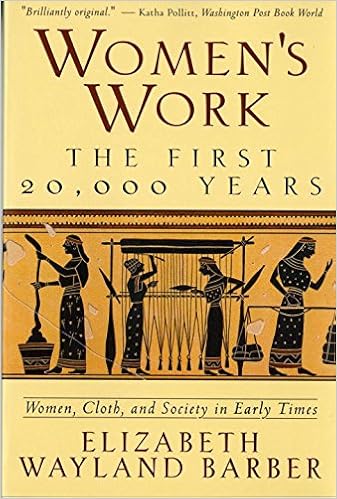
I didn't realize what I was getting into when I bought the book. I'm not sure I even knew what I was expecting until I got to chapter ten, Behind the Myths, in which she discusses the fascinating correlations between certain items of myth (such as a shirt dipped in dragon's blood will kill the wearer) and textile knowledge of the era (that there was a dye favored by royals which was nicknamed Dragons Blood and, if left in contact with the skin for a duration, would absolutely kill someone). That entire chapter was incredible, but I wouldn't have been able to enjoy it the way I did if she hadn't spent the previous nine chapters laying out the development of weaving, dying, sewing, and other crucial skills of the era. Just as I didn't know what I was expecting from the book, I didn't know how to accomplish it until the author did it for me.
History in this sense is not my forte. I love history for the stories it imparts and the lessons learned, but dates have never stuck well in my head, and so while I can recite entire sagas of the English Monarchy and discuss at length why Queen Victoria conducted her court as she did and how it influenced the courts of her descendants all the way through Elizabeth II, I have a rough time remembering when she ascended the throne. Thus, the first several chapters which are discussing the development and migration of society, and the references to those dates throughout are a bit lost on me. Barber, however, is a professor and has clearly encountered people like me before, so she provides graphs to help me follow along.
Speaking of her provided aids, Barber makes incredible use of her artistic skill to reproduce a number of important visual references. Early in the book, she shows how actually taking the time to try to reproduce historic weaving teaches a great deal about the context is which it is created, and provides the pictures of her own work doing so. When she talks about a Nineteenth Dynasty Egyptian weaving shop painted on a tomb discovered in the thirteenth century, she reproduces it for the reader. When she discusses the trade routes men took to sell wares while their women produced them, she draws simple line maps to give an idea of scale and distance. When she suggests that the Venus de Milo, whose arms would be held in an awkward position were they present, is in fact created in the exact position that Greek women held their spinning, she provides an artistic rendition of how the statue would look had the wood and wool accessories not been lost to time.
This makes a huge difference between an academic text and an engaging collaboration in understanding. I got to discover for myself the artwork that shows a change to the type of loom used in Egyptian weaving because the artwork was provided for me to examine. This elevates the text and provides engagement in a way that can be lost in a somewhat difficult topic to grapple with as history measured over the course of centuries.
The last chapter, technically labeled a postscript, was one that really pleased me to see, which was an examination of her methodology. Early in the book she explained that a lot of what constituted women's work in this part of civilization was made of perishable items - food, fabric, farming - and thus discounted for much of archaeology. That she takes such care to discuss how she went about doing the research that led to this book in the face of those challenges was both interesting and reassuring, as a description of methodology is often lacking in academic text provided for mass consumption. It pleased me greatly. She says, in reference to a gentleman who had influenced her in the field, "He never let his ego get in the way of learning, by hanging on to an idea because it was his." Wise words.
The book can be summed up by her last paragraph, and I hope that if Dr. Barber every stumbles on this she will not mind it reproduced here: "We women do not need to conjure a history for ourselves. Facts about women, their work, and their place in society in early times have survived in considerable quantity, if we know how to look for them. Far from being dull and in need of fanciful paint to make it more interesting, this truth is sometimes (as far as the saying goes) stranger than fiction, a fascinating tale in itself."
Subscribe to:
Posts (Atom)